

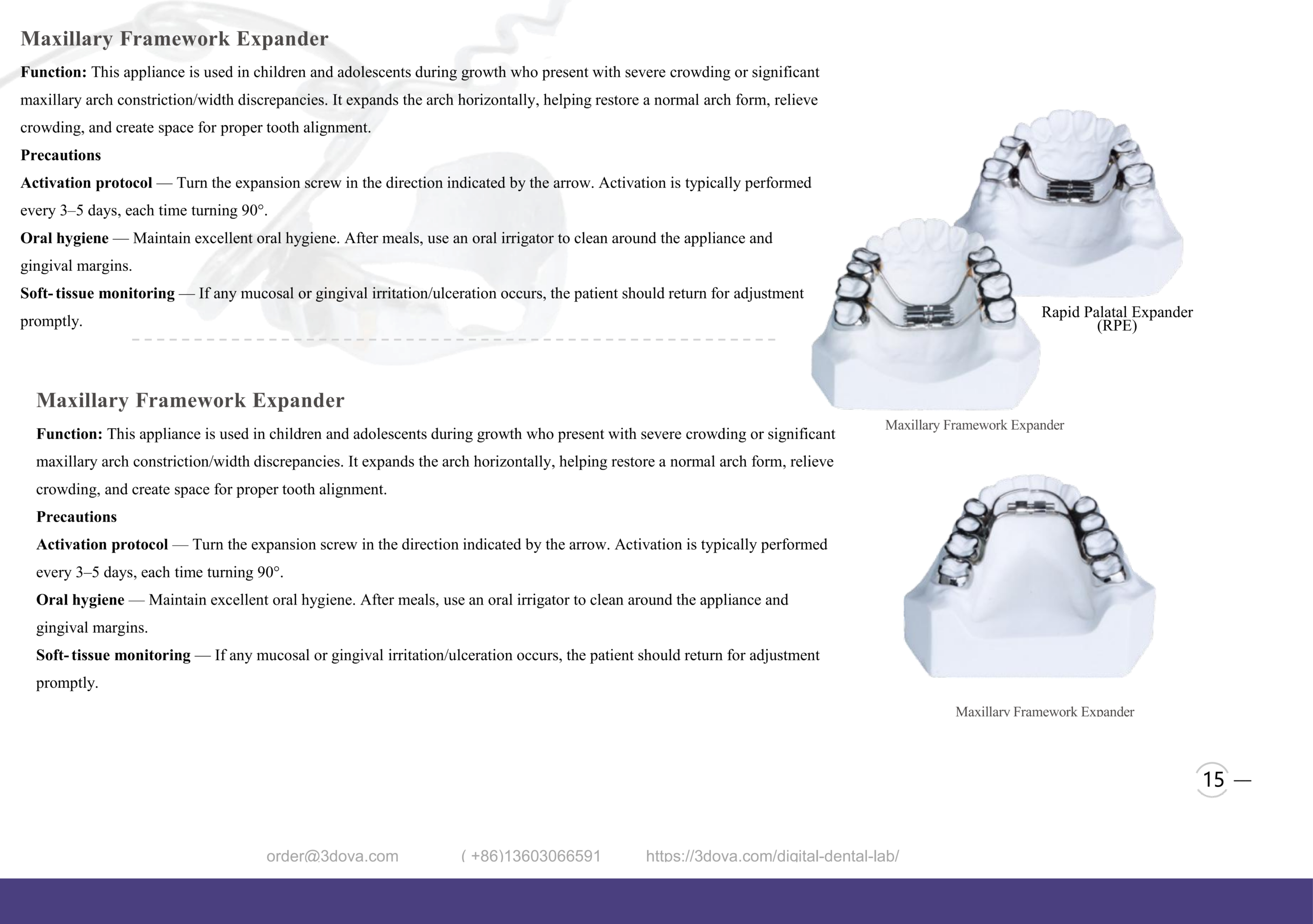
Rapid Palatal Expander: Maximizing Skeletal Arch Expansion
Correcting severe maxillary arch constriction and transverse width discrepancies in growing patients requires immediate, structurally sound orthopedic intervention. Indeed, failing to address midface narrowness early can lead to impacted dentition, crowded arches, or functional crossbites. Fortunately, selecting a fixed rapid palatal expander configuration allows clinicians to widen the arch horizontally and restore a normal, healthy arch form efficiently.
Modern digital dental laboratories fabricate highly robust wire-frame and acrylic-supported systems for these skeletal challenges. Specifically, these advanced options give practitioners absolute stability during heavy force delivery. Consequently, you can accelerate your active treatment timelines, create vital tooth alignment space, and achieve predictable sutural separation.
1. Clinical Applications of a Fixed Rapid Palatal Expander
Orthodontists widely prescribe a heavy-duty rapid palatal expander, often called an RPE or maxillary framework expander, during active growth phases in children and adolescents. This specialized device targets true skeletal narrowness rather than simple dental tipping. By utilizing a rigid expansion screw secured to banded anchor molars, it splits the midpalatal suture cleanly. As a result, the treatment resolves deep crowding and paves the way for secondary fixed appliance tracking.
Critical Activation and Soft-Tissue Monitoring Rules:
First, establish a precise patient activation schedule with the parent or guardian. The team must instruct them to turn the central expansion screw strictly in the direction indicated by the engraved arrow. Typically, clinicians prescribe adjustments every 3 to 5 days, with each individual turn rotating exactly 90 degrees. Consistent tracking ensures steady skeletal opening without overloading the periodontium.
Second, monitor the surrounding palatal soft tissues and gingival margins diligently during expansion. If any mucosal or gingival irritation, redness, or deep ulceration occurs, the patient must return to your practice promptly for an structural adjustment.
2. Maintaining Oral Hygiene During Skeletal Expansion
Because fixed appliances cover a wide area of the palatal vault, maintaining pristine oral health is vital for preventing hyperplastic gingiva or localized infection. The complex wire framework can easily trap food particles and dental plaque against the palate. Therefore, clinicians must educate families on a comprehensive daily cleaning protocol straight from the day of initial cementation.
Essential At-Home Maintenance Protocols:
First, mandate the use of specialized cleaning equipment after every meal. Families should utilize an automated oral irrigator to flush out trapped debris from underneath the screw mechanism and around the banded margins.
Second, enforce thorough manual brushing routines along the gumline to prevent localized plaque accumulation. Keeping the environment clean keeps treatment moving forward without painful tissue swelling or unexpected delays.
Streamlining Your Dental Workflows
High-accuracy lab production is essential for preventing structural relapse and shortening total seat times. For this reason, modern digital workflows can vastly improve your everyday clinical outcomes. To expand your knowledge, you can study more about early interceptive arch management guidelines by visiting authoritative industry resources like the American Association of Orthodontists and the Journal of Clinical Orthodontics.
Are you ready to optimize your chairside workflows? You can upload your digital intraoral STL scans directly through our official 3DOVA Digital Lab Platform. Additionally, feel free to explore our complete catalog of custom fixed and removable orthodontic configurations online.
Leave a Reply