

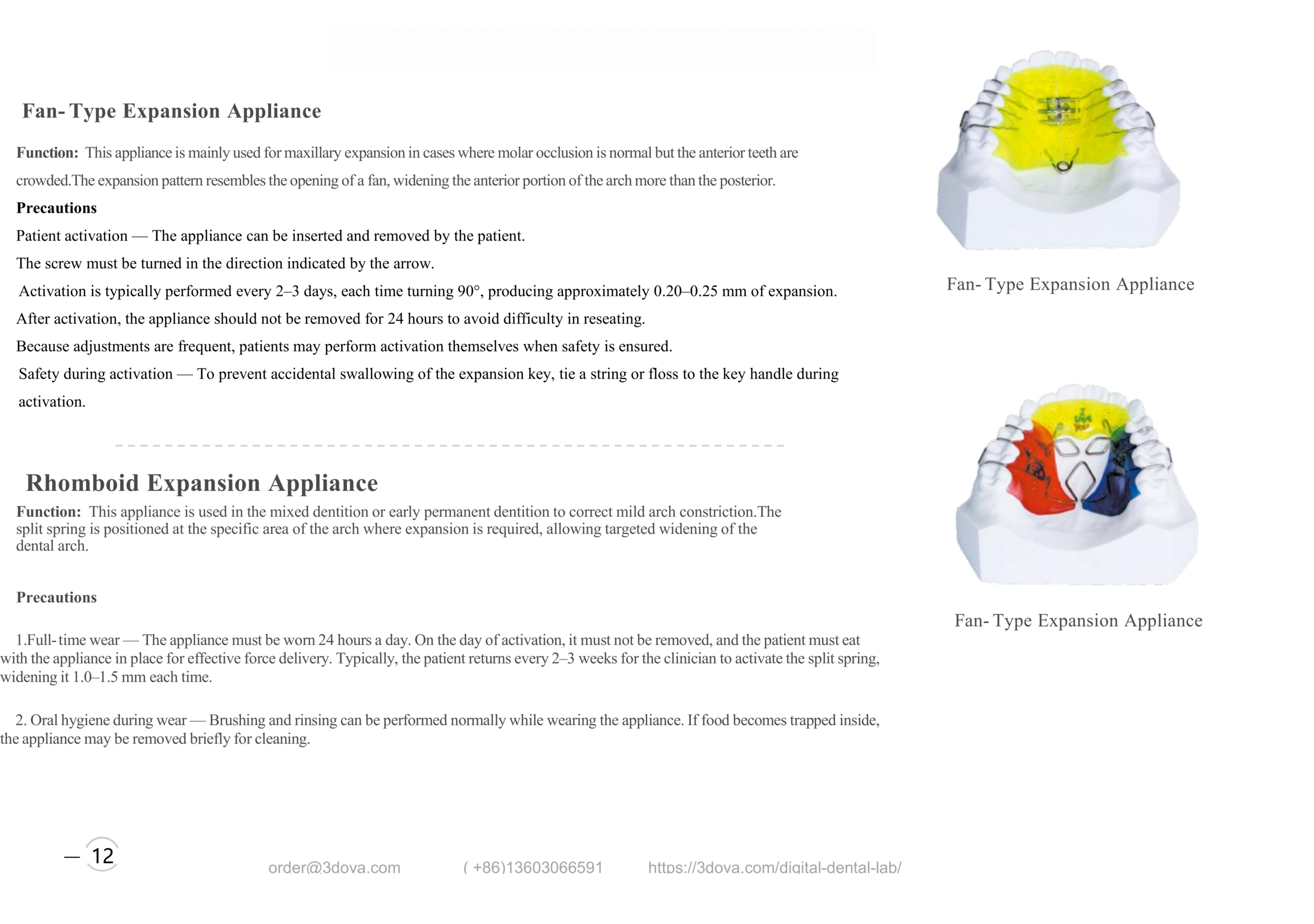
Maxillary Fan Expander: Targeted Anterior Arch Development
Addressing severe anterior dental crowding while maintaining a stable, normal molar relationship requires specialized laboratory mechanics and precise clinical management. Indeed, typical symmetric arch expansion is not always ideal when the posterior width is already correct. Fortunately, prescribing a custom maxillary fan expander configuration allows clinicians to widen the anterior portion of the arch selectively while leaving the molars unaffected.
Modern digital dental laboratories fabricate highly precise screw and spring configurations for these specialized interceptive challenges. Specifically, these advanced options give practitioners full control over localized arch discrepancies. Consequently, you can accelerate your active treatment timelines and significantly improve clinical outcomes.
1. Clinical Functions of the Maxillary Fan Expander (Fan-Type Expansion Appliance)
Orthodontists widely prescribe a maxillary fan expander for cases where molar occlusion remains normal but the anterior teeth are severely crowded. The expansion pattern resembles the opening of a hand fan. Therefore, it widens the anterior segment of the dental arch much more than the posterior segment.
Critical Activation and Safety Rules:
First, instruct the family on proper patient activation. The patient inserts and removes the appliance independently, turning the screw in the direction indicated by the arrow. Typically, activation occurs every 2 to 3 days. Each 90-degree turn produces approximately 0.20 to 0.25 mm of expansion. Following activation, the appliance must remain in the mouth for 24 hours to prevent seating difficulties.
Second, ensure absolute safety during activation. To prevent accidental swallowing of the expansion key, always tie a piece of dental floss or string to the key handle before turning.
2. Localized Arch Development (Rhomboid Expansion Appliance)
When a case requires highly localized widening outside of a fan pattern, practitioners choose a rhomboid configuration alongside a maxillary fan expander treatment philosophy. This split-spring setup is indicated in the mixed dentition or early permanent dentition to correct mild arch constriction. Because the split spring is positioned at a specific area of the arch, it allows for highly targeted widening where it is needed most.
Critical Adjustment Guidelines:
First, enforce strict full-time wear for 24 hours a day. On the day of activation, the patient must not remove the appliance and must eat meals with it in place for effective force delivery. Typically, the patient returns every 2 to 3 weeks for the clinician to activate the split spring, widening it 1.0 to 1.5 mm each time.
Second, emphasize strict oral hygiene. Brushing and rinsing can be performed normally while wearing the appliance. However, if food becomes trapped inside, the appliance may be removed briefly for cleaning.
Streamlining Your Dental Workflows
High-accuracy lab production is essential for preventing structural relapse and shortening total seat times. For this reason, modern digital workflows can vastly improve your everyday clinical outcomes. To expand your knowledge, you can study more about early interceptive arch management guidelines by visiting authoritative industry resources like the American Association of Orthodontists and the Journal of Clinical Orthodontics.
Are you ready to optimize your chairside workflows? You can upload your intraoral STL scans directly through our official 3DOVA Digital Lab Platform. Additionally, feel free to explore our complete catalog of custom removable orthodontic configurations online.
Leave a Reply