

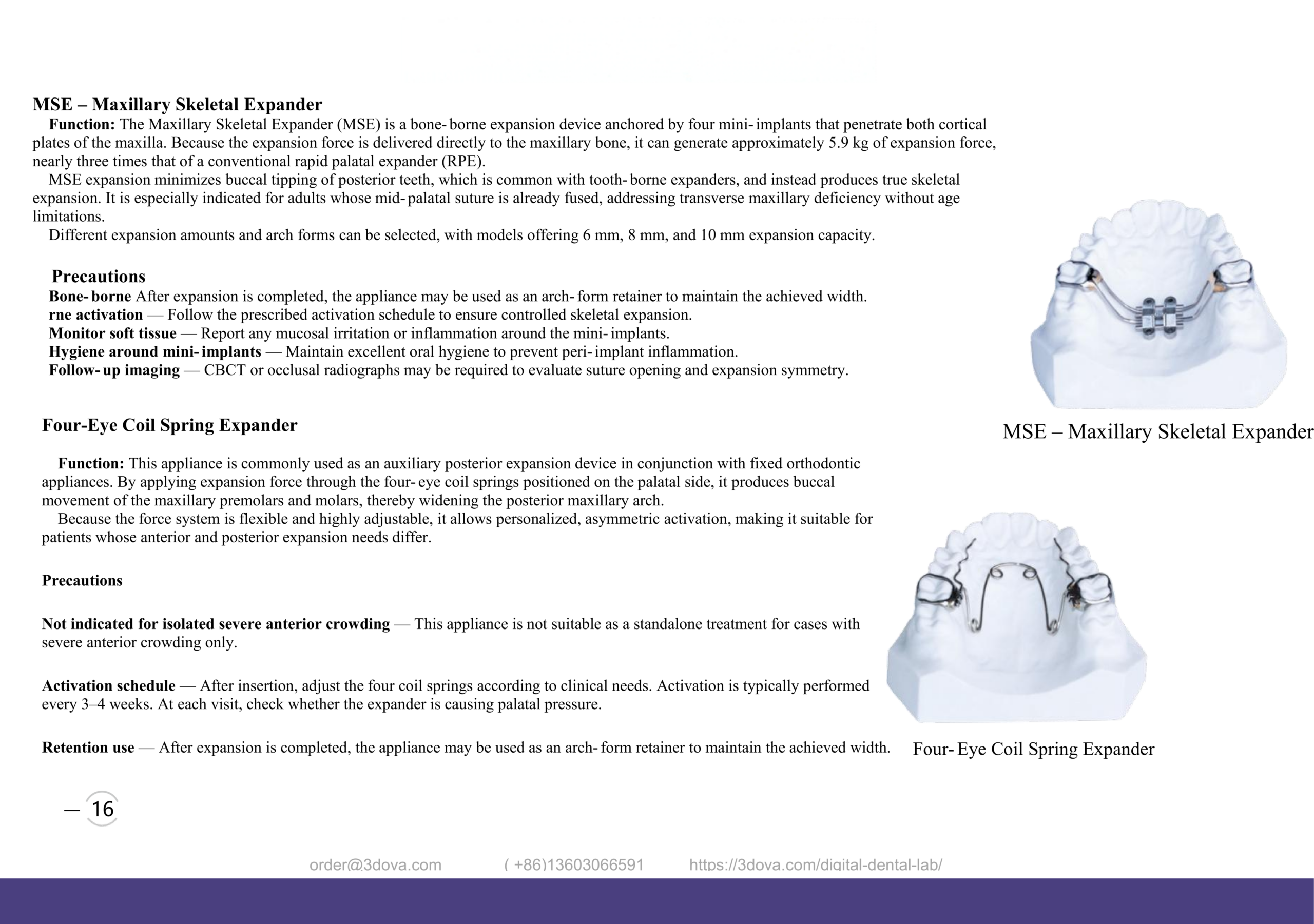
Maxillary Skeletal Expander: Advanced Bone-Borne Expansion
Overcoming transverse maxillary deficiency in mature adolescent or adult patients requires heavy, highly targeted orthopedic force. Indeed, conventional tooth-borne rapid palatal expanders often cause unwanted buccal tipping or periodontal damage once the mid-palatal suture begins fusing. Fortunately, utilizing a bone-borne maxillary skeletal expander configuration provides a revolutionary method to achieve true skeletal expansion without age-based limitations.
Modern digital dental laboratories fabricate highly precise micro-implant supported frameworks for these advanced skeletal cases. Specifically, these rigid designs deliver expansion forces straight to the baseline maxillary bone structure. Consequently, you can expand mature arches predictably, minimize adverse dental movements, and dramatically elevate your non-surgical clinical options.
1. Biomechanics of the Maxillary Skeletal Expander (MSE)
Orthodontists widely prescribe a maxillary skeletal expander as a premier bone-borne device anchored by four temporary mini-implants. Because these micro-implants penetrate both cortical plates of the maxilla, the setup transfers expansion force directly to the bone. This heavy structural system delivers approximately 5.9 kg of expansion force. Remarkably, this represents nearly three times the force profile generated by traditional tooth-borne designs.
Critical Precaution and Post-Insertion Check Steps:
First, enforce a meticulous hygiene regimen around mini-implants straight from the day of insertion. The patient must maintain excellent oral hygiene to prevent peri-implant soft-tissue inflammation or local infection. If any mucosal swelling, chronic bleeding, or deep tissue irritation occurs around the micro-implants, evaluate the site promptly.
Second, schedule necessary follow-up imaging to verify your clinical tracking. Orthodontists should utilize CBCT scans or occlusal radiographs after expansion sequences to evaluate mid-palatal suture opening and verify structural expansion symmetry.
2. Auxiliary Posterior Expansion (Four-Eye Coil Spring Expander)
When a case requires flexible dental expansion rather than a rigid bone-borne suture split, clinicians implement a Four-Eye Coil Spring Expander. Practitioners commonly use this appliance as a flexible auxiliary expansion device alongside traditional fixed braces. By applying continuous spring forces through four palatal coil loops, it prompts the buccal movement of the maxillary premolars and molars.
Clinical Indications and Adjustment Rhythms:
First, note that this spring-loaded wire framework is not indicated for isolated severe anterior crowding. Because the force vectors target the posterior segments, use it primarily to resolve isolated posterior crossbites or widen a narrow posterior arch form.
Second, maintain a structured activation schedule every 3 to 4 weeks. At each office visit, carefully adjust the four coil loops based on your expansion goals and evaluate the palatal vault to prevent unwanted soft-tissue pressure.
Streamlining Your Dental Workflows
High-accuracy lab production is essential for ensuring precise implant alignment and minimizing chairside complications. For this reason, modern digital workflows can vastly improve your everyday clinical outcomes. To expand your knowledge, you can study more about skeletal expansion guidelines by visiting authoritative industry resources like the American Association of Orthodontists and the Journal of Clinical Orthodontics.
Are you ready to optimize your chairside micro-implant workflows? You can upload your intraoral STL scans and CBCT data directly through our official 3DOVA Digital Lab Platform. Additionally, feel free to explore our complete catalog of custom fixed and bone-borne orthodontic configurations online.
Leave a Reply