

Catlan’s Appliance: Interceptive Crossbite Correction Guide
Correcting anterior dental crossbites in early mixed dentition requires immediate, reliable biomechanical intervention. Failing to treat these issues early can cause localized periodontal damage or unwanted functional shifts. Fortunately, selecting Catlan’s Appliance allows clinicians to achieve rapid, highly predictable interceptive results.
Modern digital dental laboratories fabricate highly effective configurations for these pediatric challenges. These options integrate specialized clinical designs to unlock trapped anterior teeth smoothly. Consequently, you can accelerate your active treatment timelines and significantly improve client satisfaction.
1. Clinical Functions of Catlan’s Appliance
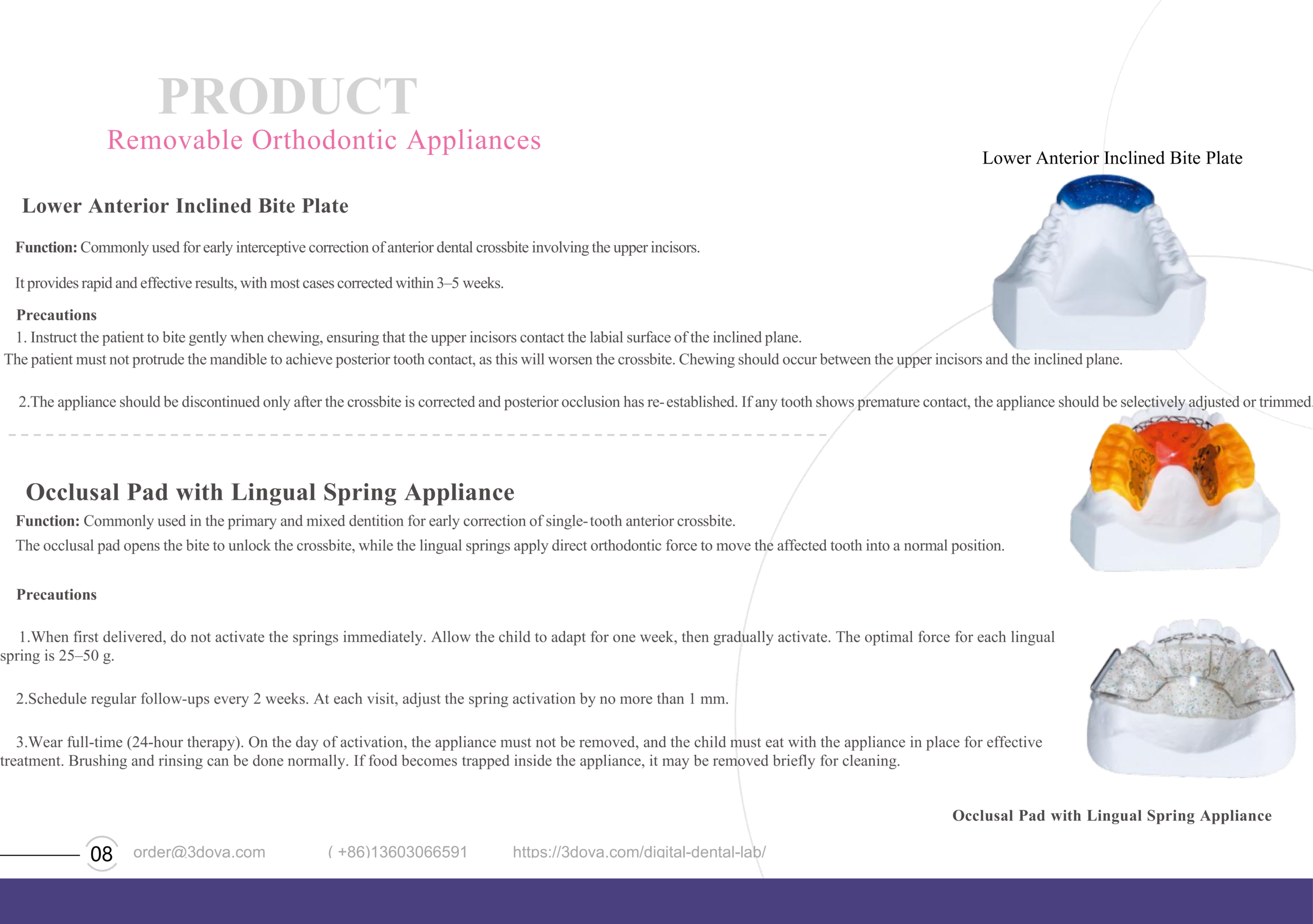
Orthodontists widely prescribe Catlan’s Appliance, structurally known as the lower anterior inclined bite plate, for early interceptive correction. This specialized configuration treats simple anterior crossbites involving the upper permanent incisors. Because of its steep mechanical trajectory, this appliance provides exceptionally rapid results. In fact, most uncomplicated cases reach full correction within just 3 to 5 weeks.
Critical Clinical Verification Steps:
First, instruct the patient to bite very gently when chewing food. You must ensure that the upper incisors contact the labial surface of the inclined plane correctly. The patient must never protrude the mandible to force posterior tooth contact. Otherwise, this habit will actively worsen the existing crossbite.
Second, maintain the therapy until you achieve proper tooth alignment. You should discontinue Catlan’s Appliance only after the crossbite is fully corrected and stable posterior occlusion re-establishes. If any individual tooth shows premature contact during follow-ups, carefully trim or selectively adjust the acrylic surface.
2. Comparing Alternative Interceptive Solutions (Hawley with Z-Spring)
When a lower inclined plane is not ideal for multiple teeth, an alternative option functions similarly to a modified Hawley with a Z-Spring. This distinct design targets single-tooth anterior crossbites using an integrated posterior occlusal pad. The pad opens the bite to unlock the trapped tooth. Simultaneously, active lingual springs apply direct, controlled orthodontic force to move the affected tooth into a normal position.
Critical Treatment Verification Steps:
First, do not activate the wire components immediately when you first deliver the case. Allow the child to adapt comfortably to the bulk of the acrylic for one week. After this phase, you can gradually activate the springs. Keep in mind that the optimal force for each individual lingual spring is 25–50 g.
Second, schedule regular clinical follow-ups every 2 weeks. At each office visit, safely adjust the spring activation by no more than 1 mm. Finally, enforce strict full-time, 24-hour compliance to guarantee clinical efficacy.
Streamlining Your Dental Workflows
High-accuracy lab production prevents unexpected relapse and shortens total treatment time. For this reason, modern digital workflows can vastly improve your everyday clinical outcomes. You can study more about early interceptive guidelines by visiting authoritative industry resources like the American Association of Orthodontists and the Journal of Clinical Orthodontics.
Are you ready to optimize your chairside seat times? Please submit your digital or analog impressions directly to our qualified technician team. Additionally, you can explore our complete line of modern orthodontic configurations at the official 3DOVA Digital Lab Platform.
Leave a Reply