

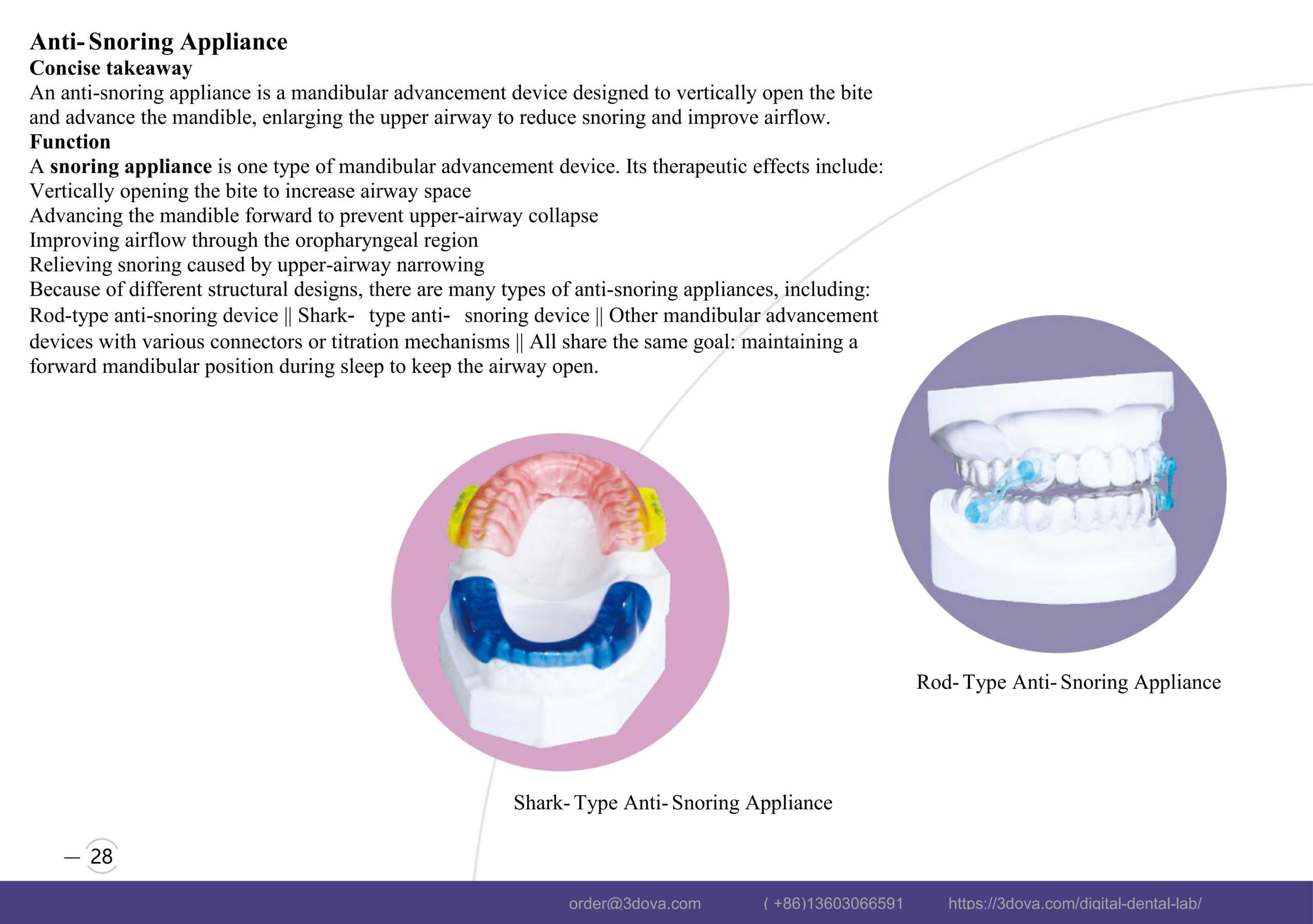
Anti-Snoring Appliance: Advanced Mandibular Advancement Mechanics
Managing sleep-disordered breathing and upper airway resistance in adult dental patients requires highly precise clinical data and incredibly robust laboratory engineering. Indeed, addressing structural airway narrowing during sleep is critical for preventing upper-airway collapse and improving overall systemic health. Fortunately, prescribing a custom anti-snoring appliance configuration provides clinicians with a highly predictable, non-invasive method to stabilize the lower jaw and optimize nocturnal airflow.
Modern digital dental laboratories fabricate advanced split-splint structures to handle these complex sleep medicine cases. Specifically, these advanced structural options safely hold the lower jaw in a forward position throughout the night. Consequently, you can expand your practice’s clinical offerings, reduce therapeutic seat times, and significantly improve patient sleep quality.
1. Biomechanics of the Anti-Snoring Appliance
Practitioners widely prescribe a custom-milled or printed anti-snoring appliance as a premier type of mandibular advancement device (MAD). Mechanically, the split-splint framework acts to vertically open the patient’s bite. This structural separation instantly increases the available three-dimensional airway space. Simultaneously, the appliance locks the lower jaw forward to prevent the tongue and soft palate from collapsing backward into the throat. Together, these smooth mechanical forces effectively relieve snoring caused by upper-airway narrowing.
Structural Device Configurations Available:
Depending on your patient’s specific jaw morphology and lateral movement needs, modern labs categorize these therapeutic devices into two primary physical layouts:
- Rod-Type Anti-Snoring Device: This design utilizes sleek, lateral telescopic rods or connectors to guide the jaw path. It offers highly precise linear advancement options.
- Shark-Type Anti-Snoring Device: This alternative features an integrated posterior fin or wing mechanism to hold the forward position. It gives patients excellent lateral freedom while maintaining a continuous airway opening.
2. Critical Clinical Verification and Impression Rules
Because sleep-disordered breathing hardware undergoes continuous, heavy loading during bruxism or sleep cycles, achieving an ultra-precise laboratory fit is vital for clinical success. Poorly managed jaw registrations or shallow models lead directly to localized muscle fatigue, TMJ discomfort, or a complete failure to seat. Therefore, clinicians must maintain a strict record-collection protocol.
Essential Laboratory Capture Guidelines:
First, secure highly detailed impressions or intraoral scans of both arches. The clinical team must fully capture the final molar regions and complete structural tooth anatomy. Doing so ensures the laboratory can construct tight, retentive splints that will not slip out of position overnight.
Second, provide a precise protrusive bite registration using a specialized gauge. Typically, clinicians target an initial advancement of 50% to 70% of the patient’s maximum protrusion range. This careful setting provides an optimal balance between maximum airway patency and minimal TMJ strain.
Streamlining Your Dental Sleep Workflows
High-accuracy lab production is a cornerstone of preventing unexpected tooth movement and minimizing chairside titration adjustments. For this reason, modern digital workflows can vastly improve your everyday clinical outcomes. To expand your knowledge, you can study more about professional dental sleep medicine guidelines by visiting authoritative industry resources like the American Academy of Dental Sleep Medicine and the Journal of Clinical Orthodontics.
Are you ready to optimize your chairside dental sleep workflows? You can send your request directly to order@3dova.com. Additionally, feel free to explore our complete online catalog of custom fixed, removable, and airway-focused orthodontic configurations.
Leave a Reply