

Functional Orthopedic Appliance: Advanced Growth & Muscle Modification
Managing developing skeletal discrepancies during early growth phases requires highly precise clinical timing and absolute structural accuracy. Indeed, targeting dysfunctional perioral muscle patterns early allows clinicians to harness natural adaptive remodeling before structural growth centers close. Fortunately, implementing a targeted functional orthopedic appliance strategy provides clinicians with a highly predictable path toward establishing normal muscle balance and guiding skeletal development.
Modern digital dental laboratories fabricate advanced muscle-stimulating configurations for these early myofunctional challenges. Specifically, these custom choices manipulate the oral environment to eliminate aberrant neuromuscular forces acting on the dentition. Consequently, you can accelerate active orthopedic treatment timelines and significantly improve structural predictability.
1. The Myotonic Activator (Muscle-Stimulating Appliance)
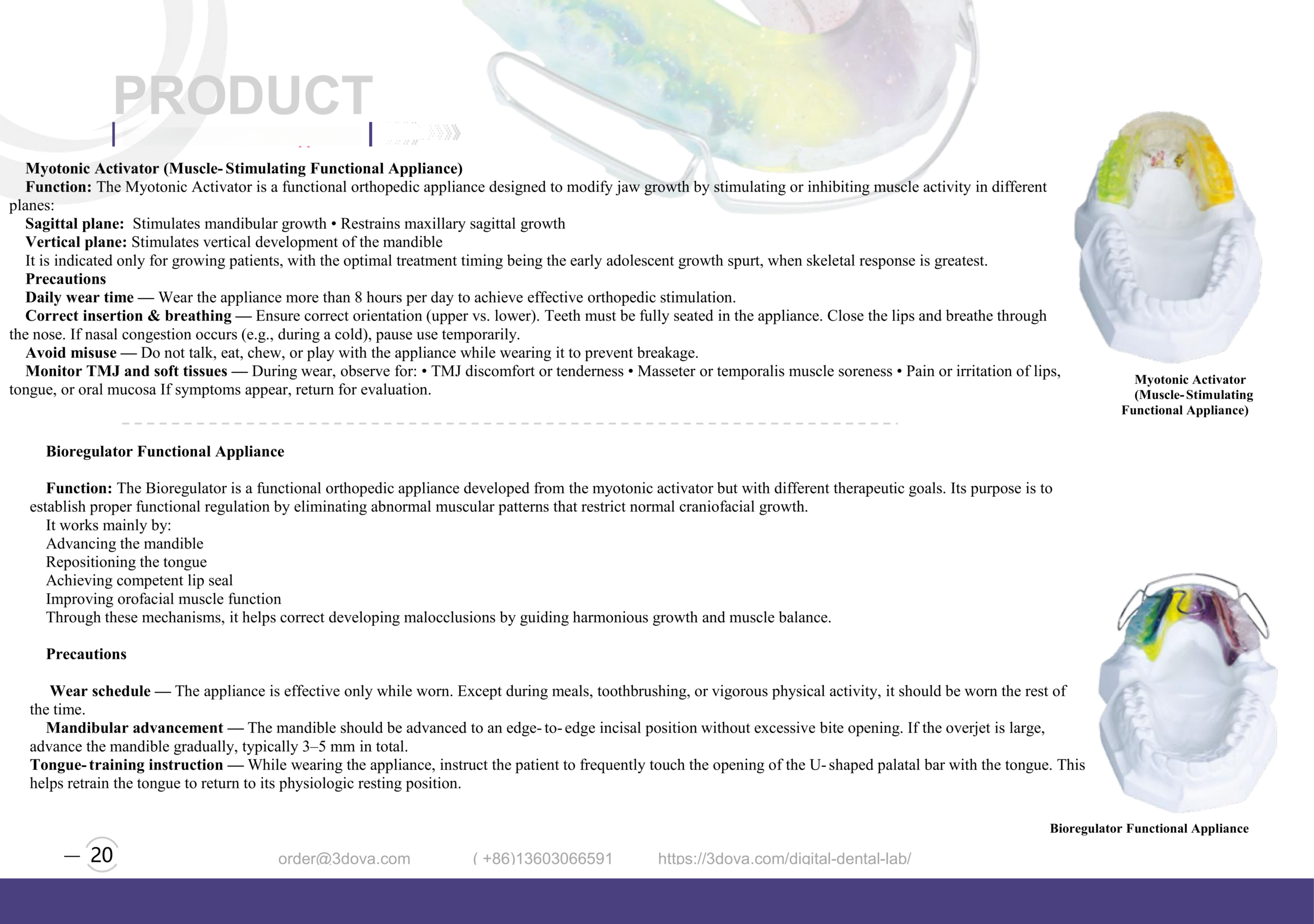
Orthodontists widely prescribe the Myotonic Activator variation of a functional orthopedic appliance to modify jaw growth by stimulating or inhibiting muscle activity across different planes. In the sagittal plane, it effectively stimulates mandibular growth while restraining maxillary forward progress. Vertically, it actively stimulates the vertical development of the mandible. This device is indicated only for growing patients. Optimally, the treatment timing should coincide directly with the early adolescent growth spurt, when the skeletal response is greatest.
Critical Wear and Soft-Tissue Monitoring Rules:
First, mandate an accurate daily wear time protocol with the family. The patient must wear the appliance for more than 8 hours per day to achieve effective orthopedic stimulation. Furthermore, ensure proper insertion orientation. The teeth must seat fully within the acrylic blocks, the lips must close, and the patient must breathe comfortably through the nose. If nasal congestion occurs due to a cold, pause wear temporarily.
Second, monitor the temporomandibular joint and muscle tissues closely at every follow-up visit. During the active wear phases, observe the patient for any signs of TMJ discomfort, masseter tenderness, or temporalis muscle soreness. If symptoms or deep irritation of the lips, tongue, or oral mucosa appear, evaluate the appliance contours immediately.
2. The Bioregulator Functional Appliance
When a pediatric case requires the elimination of abnormal muscular patterns restricting craniofacial growth rather than pure mechanical stimulation, practitioners choose a Bioregulator. This specialized functional orthopedic appliance acts by advancing the mandible, repositioning the tongue, achieving lip seal, and improving overall orofacial muscle function. Through these mechanisms, it guides harmonious growth and muscle balance.
Critical Adjustment and Training Guidelines:
First, enforce a strict mandibular advancement position during your master bite registration. The mandible should be advanced into a clean, edge-to-edge incisal position without excessive vertical opening. However, if the initial overjet is large, you should advance the mandible gradually over time, typically targeting 3 to 5 mm in total advancement per step.
Second, implement a continuous tongue-training instruction protocol. While wearing the appliance, instruct the patient to frequently touch the opening of the integrated U-shaped palatal bar with the tip of their tongue. This active exercise successfully retrains the tongue to return to its ideal, physiologic resting position.
Streamlining Your Dental Workflows
High-accuracy lab production is essential for preventing muscle fatigue and shortening overall chairside seat times. For this reason, modern digital workflows can vastly improve your everyday clinical outcomes. To expand your knowledge, you can study more about early myofunctional interceptive guidelines by visiting authoritative industry resources like the American Association of Orthodontists and the Journal of Clinical Orthodontics.
Are you ready to optimize your chairside workflows? You can send your request directly to order@3dova.com. Additionally, feel free to explore our complete online catalog of custom fixed, removable, and functional orthodontic configurations.
Leave a Reply