

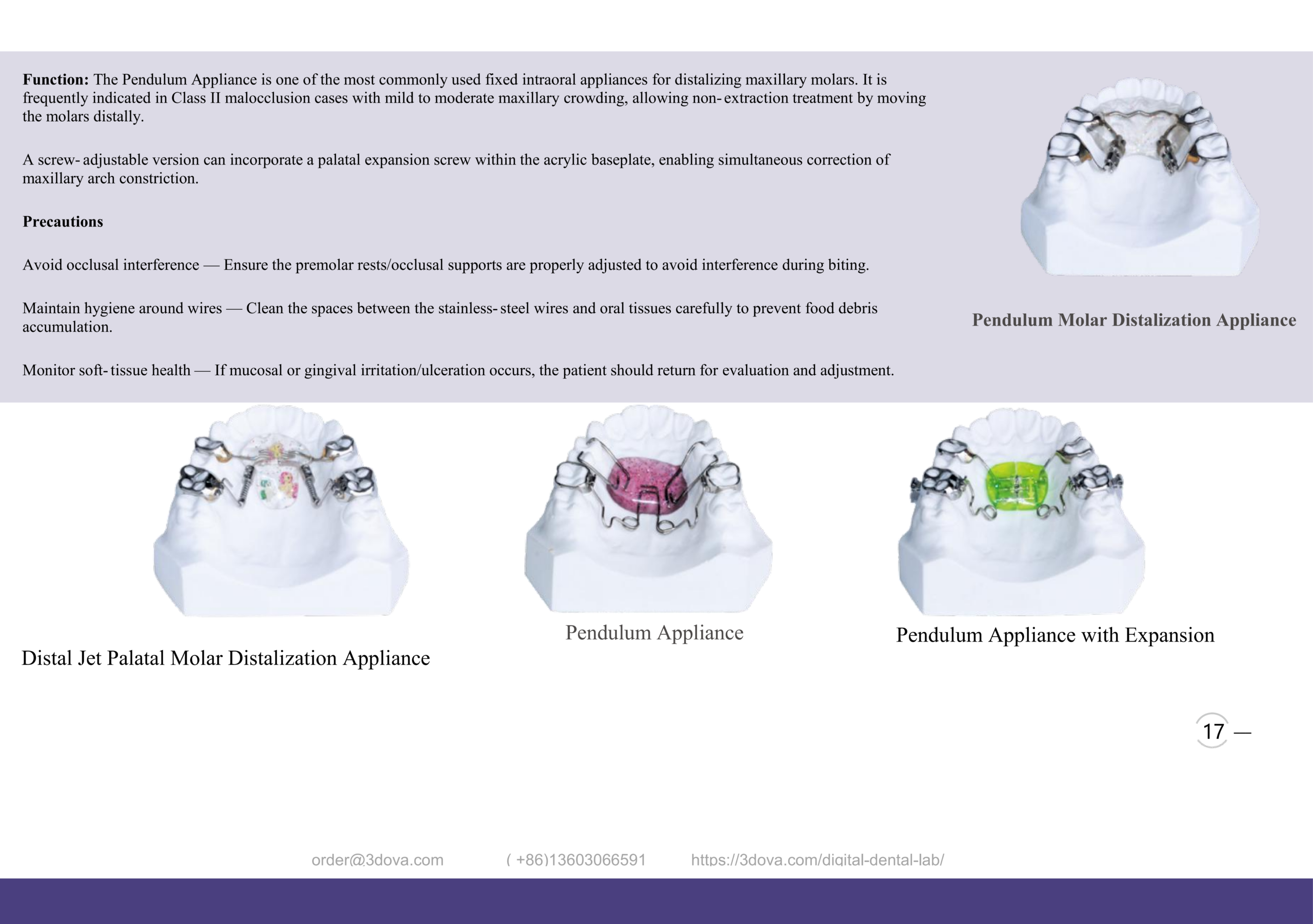
Pendulum Molar Distalization Appliance: Advanced Class II Correction
Achieving predictable sagittal correction while avoiding unnecessary extractions in growing dental patients requires highly efficient intraoral mechanics and reliable laboratory designs. Indeed, managing moderate maxillary crowding alongside true Class II discrepancies requires specialized tools that operate independent of patient compliance. Fortunately, selecting a custom fixed pendulum molar distalization appliance strategy provides clinicians with a robust, reliable path toward creating adequate arch perimeter.
Modern digital dental laboratories fabricate highly secure fixed and screw-adjustable configurations for these orthodontic challenges. Specifically, these advanced structural options give practitioners direct control over posterior space preparation. Consequently, you can accelerate your active treatment timelines, correct dental relationships smoothly, and achieve exceptional clinical outcome stability.
1. Biomechanics of the Pendulum Molar Distalization Appliance
Orthodontists widely prescribe a pendulum molar distalization appliance as a premier fixed option for distalizing maxillary molars. This device works excellently for Class II malocclusion cases presenting with mild to moderate maxillary crowding. By utilizing a secure, tissue-borne acrylic palatal button coupled with flexible titanium-molybdenum alloy springs, it moves upper molars distally along an arc. Furthermore, a screw-adjustable version can incorporate a palatal expansion screw within the central acrylic baseplate. This integration enables simultaneous correction of maxillary arch constriction alongside sagittal movement.
Critical Precaution and Seating Check Steps:
First, avoid occlusal interference completely during initial delivery. The clinician must ensure that the premolar rests and occlusal wire supports are properly adjusted to avoid any interference or premature contacts during biting.
Second, monitor soft-tissue health diligently at every single follow-up appointment. The clinical team must inspect the palatal mucosa surrounding the button for inflammation. If any mucosal or gingival irritation or deep ulceration occurs, the patient should return to your office immediately for local adjustments.
2. Alternative Space Maintenance (Distal Jet Palatal Molar Distalization Appliance)
When a clinician prefers purely linear distal translation over the arc-like rotational movement of springs, they choose a Distal Jet Palatal Molar Distalization Appliance. Practitioners utilize this alternate piston-and-tube design to achieve bodily movement of the upper molars. Because the force vectors track through a rigid, parallel tracks mechanism, it minimizes unwanted molar tipping while preparing required arch space efficiently.
Essential Maintenance and Hygiene Protocols:
First, maintain absolute cleanliness around all active spring and slider mechanisms. Because fixed palatal hardware covers broad surfaces, families must clean the tight spaces between the stainless-steel wires and oral tissues carefully to prevent food debris accumulation.
Second, inspect the locks and wire assemblies frequently. Enforcing excellent home care and scheduling regular clinical checks ensures the mechanics continue tracking smoothly without unwanted trajectory shifts or sudden treatment delays.
Streamlining Your Dental Workflows
High-accuracy lab production is a cornerstone of preventing anchoring loss and shortening total chairside adjustment times. For this reason, modern digital workflows can significantly enhance clinical outcomes. To expand your knowledge, you can study more about early interceptive anchorage guidelines by visiting authoritative industry resources like the American Association of Orthodontists and the Journal of Clinical Orthodontics.
Are you ready to optimize your chairside workflows? You can upload your digital intraoral STL scans directly to order@3dova.com.Additionally, feel free to explore our complete catalog of custom fixed and removable orthodontic configurations online.
Leave a Reply