

Advanced Lab Insights: Selecting the Right Removable Orthodontic Retainers
Achieving a precise treatment outcome is only the first step. Long-term post-orthodontic stability requires high-fidelity removable orthodontic retainers. These appliances must respect your extraction strategies and space-closure goals. At 3Dova, our digital lab combines precise thermoforming with traditional bench wirework. Consequently, we fabricate resilient, clinical-grade appliances adapted exactly to your intraoral scans.
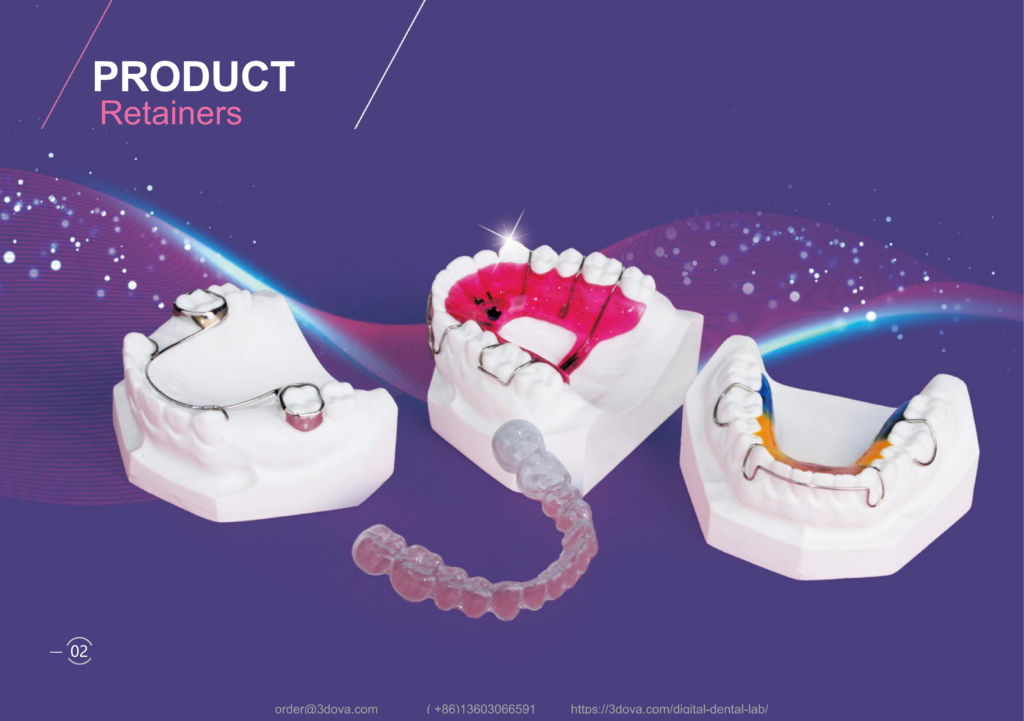
When prescribing specialized removable retention frameworks for post-extraction cases, two primary lab configurations offer distinct clinical advantages:
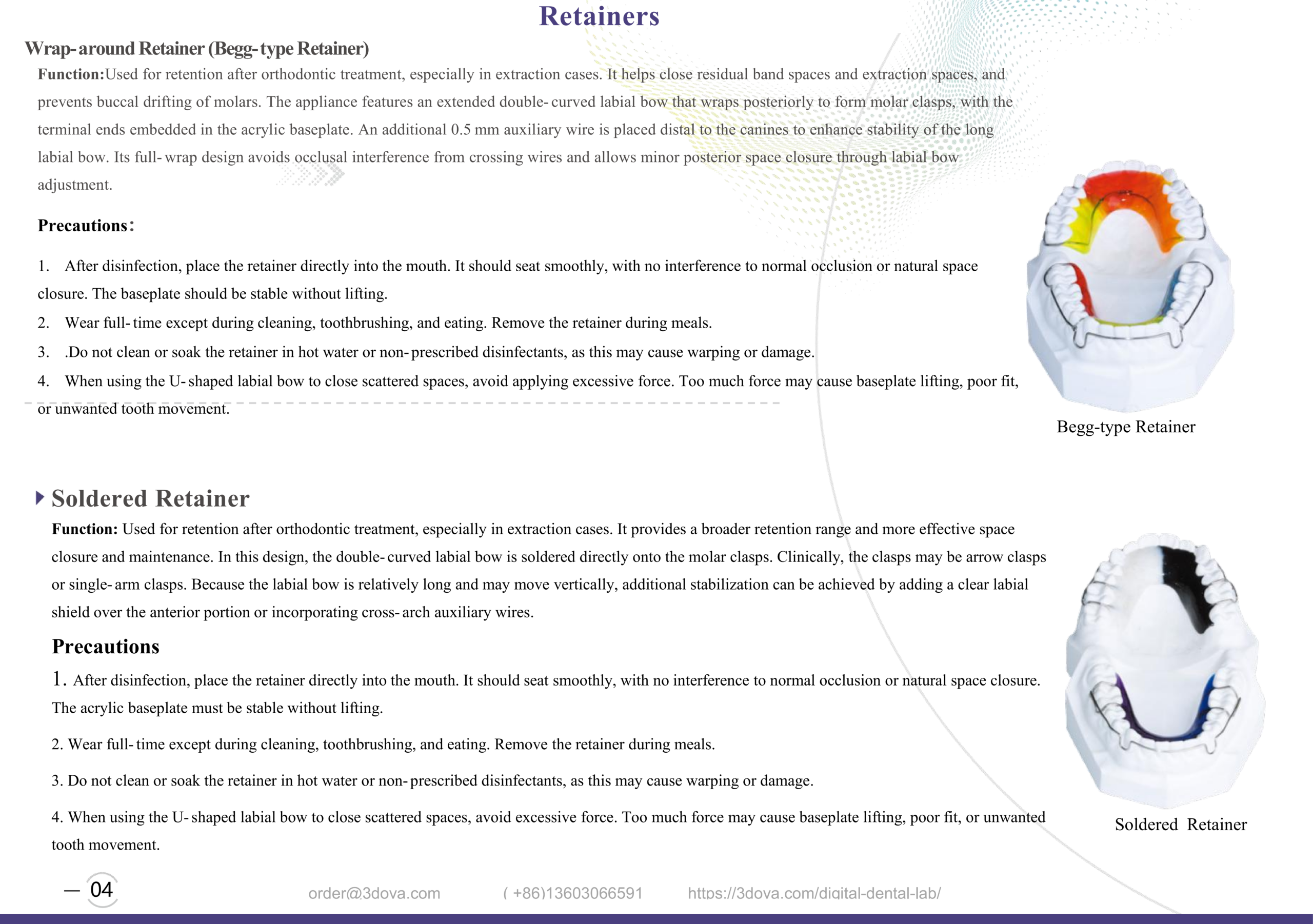
1.Wrap-around Removable Orthodontic Retainers (Begg-type)
This framework is engineered for cases requiring unhindered posterior seating. Additionally, it allows for active arch refinement without occlusive disturbance.
Delivery & Precautions: However, you must ensure the acrylic baseplate seats fully without lifting or rocking. Advise clinicians and patients that excessive activation force can cause baseplate instability. As a result, this may lead to unexpected, adverse tooth movement.
Design & Architecture: First, it features an extended, double-curved labial bow. This bow wraps posteriorly to form secure molar clasps. Next, the terminal ends are embedded directly into a rigid acrylic baseplate. Finally, a critical 0.5 mm auxiliary wire is adapted distal to the canines to maximize structural stability.
Clinical Advantages: The full-wrap architecture completely eliminates occlusal interference. It achieves this by routing wires away from interproximal embrasures. Therefore, you can execute minor posterior space closure and arch settling smoothly through direct labial bow adjustment.
2.Soldered Removable Orthodontic Retainers Framework
This stable configuration is designed for high-demand retention cases. It is especially useful when patients need comprehensive space maintenance and broad-spectrum stabilization.
Delivery & Precautions: During delivery, verify a smooth, passive fit that does not disrupt natural occlusion. Furthermore, remind clinical teams to instruct patients to never immerse these acrylic appliances in hot water. Doing so will warp the baseplate and degrade retentive precision.
Design & Architecture: In this stable framework, the double-curved labial bow is soldered directly onto the anchoring molar clasps. For example, these can be arrow clasps or single-arm configurations. To mitigate the structural flexibility of a long labial wire, you can reinforce the appliance with an anterior clear labial shield.
Clinical Advantages: Consequently, this design provides exceptional broad-range retention forces. It also ensures highly effective space closure maintenance, which is particularly valuable in complex extraction cases.
Streamlining Your Digital Case Submission
In conclusion, both specialized appliances support continuous, full-time wear protocols. 3Dova maps your digital STL files to exact physical frameworks to ensure predictable chairside delivery. To learn more about our digital integration, explore our comprehensive breakdown of 3D clear aligner manufacturing processes. You can also check out the official American Association of Orthodontists guidelines on retention for updated clinical protocols.
Ready to submit your next orthodontic case?
Upload your STL data directly via our Digital dentistry solutions or consult our technician team at order@3dova.com.
Leave a Reply